Vampiric abstention
The RadleysVampiric abstention is the practice of refusing to kill or convert others and maintaining an apparently ordinary, blood-free human life. For the Radleys, it offers a way to live among humans without openly preying on them, but it does not erase either the needs associated with vampirism or the strain of hiding them. The family’s experience presents abstention as an ongoing discipline: one that must be defended in daily routines, taught through rules, and tested by illness, bullying, secrecy, and the appeal of blood.
Definition and family history
Peter Radley explains the family’s position to Rowan as a refusal to kill or convert anyone anymore. Their outward appearance as average human beings is therefore part of the practice: abstention depends both on restraint and on keeping the truth from the outside world. The Radleys’ history also distinguishes inherited vampirism from conversion. Peter says that he has always been a vampire and that the Radleys have been vampires for generations, whereas Helen Radley was converted. Abstention is thus a way of living with an existing condition, not a change in what the family is.
The distinction matters because conversion remains consequential even within a family committed to abstaining. The account of the night before Paris recalls Will Radley and Helen’s intimacy and the first bite that preceded her conversion. Later, when Eve Copeland is gravely injured, Helen warns that giving her blood will make her a vampire and that the converted person may develop very strong feelings toward whoever supplies the blood. Eve asks for Rowan’s blood, and he uses it to save her. As she wakes, she recognizes him through a profound bond created by the blood exchange. The scene makes clear that abstention’s prohibition on conversion has emotional as well as ethical stakes: blood can preserve a life while changing its relationship to others.
The work of appearing ordinary
Abstention requires practical measures against the risks of ordinary life. Sunlight remains hazardous, so the family relies on skin-care guidance intended to reduce damage and disease while allowing abstainers to be out during the day. The effort to fit into human society is also a deliberate family policy. When Rowan is bullied, Peter and Helen consider homeschooling him, which would keep him in constant shade and away from the immediate torment. Helen ultimately rejects that solution because the handbook urges abstainers to integrate wherever possible. Integration may help the children participate in ordinary life, but it cannot shield them completely from bullying, gossip, or situations that might provoke an OBT attack.
The concealment extends into medical care. While treating a patient, Peter privately considers how he might frighten Clara Radley back into eating meat, weighing possible health consequences. His medical knowledge also gives him a way to rationalize the family’s lies: he thinks of reassurance and confidence as forms of treatment, like altering how a tablet is presented. But the justification grows harder for him over time. The episode shows abstention’s domestic cost in miniature: even concern for a child’s health is entangled with secrecy, and a doctor’s professional language can become a cover for what the family cannot openly explain.
Rules, risks, and blood dependence
The handbook presents abstention as vulnerable to overwhelming blood thirst, described as its most common danger. Its advice begins with withdrawal from other people: someone who feels an attack coming should leave the company of both Unbloods and vampires and seek quiet. Such instructions treat restraint not as a matter of will alone but as a practice of managing circumstances before craving becomes harder to control.
The text contrasts abstainers with practicing vampires, who may kill an Unblood occasionally while trying to balance those kills with the safer consumption of vampire blood. Vampire blood is described as more satisfying and complex than human blood, with blood taken just after conversion prized above all. Will Radley departs from even that pattern: after leaving his post at Manchester University, he kills increasingly often in Manchester, drinks bottles of vampire blood, and continues to drink from Isobel Child, yet reportedly has little interest in converting anyone. His conduct clarifies what abstention rejects, while also showing that access to vampire blood does not by itself guarantee restraint.
Temptation and relapse
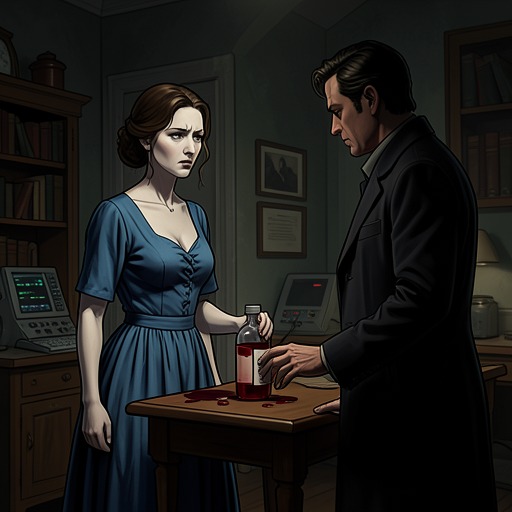
The handbook warns that blood does not satisfy craving but magnifies it, a principle Rowan encounters directly. After enduring sustained bullying, he takes up a bottle of vampire blood and drinks to Harper; the immediate effect is relief from his worries and familiar aches. The episode links a specific trigger to a short-term reward without presenting that reward as a cure. The bottle has been a temptation even before he drinks: Rowan holds it, imagines taking only a tiny sip, and hides it when he hears Clara approaching. Later, faced with it again, he argues with himself that he cannot take what he has been taught to hate, then begins to bring the bottle to his lips. The recurrence shows how abstention can be undermined by the promise of a controlled, limited exception.
The practice also carries psychological costs. Rowan finds a note in The Abstainer’s Handbook (second edition) stating that suicidal depression is common among those who abstain. That warning places his distress within the family’s account of abstainer life, while his experience of bullying gives it a concrete context. The book does not treat abstention as a simple moral victory over appetite: it records the burdens of refusal alongside the risks of drinking, and leaves the family trying to manage both.
Limits and significance
Vampiric abstention depends on repeated choices, protective routines, and a fragile balance between concealment and participation in human life. Its rules may reduce danger, but the family cannot guarantee insulation from provocation or the effects of blood. Rowan’s first drinking episode demonstrates its immediate appeal; his later use of his own blood to convert Eve demonstrates that the boundary against conversion can be crossed in an emergency, with lasting relational consequences. Through these contrasts, abstention emerges not as freedom from vampiric nature but as an effort to govern it—one whose discipline is continually tested by the very human needs for safety, belonging, relief, and love.